Guide
The 13-week cash flow forecast: what it is and how to build one
What it looks like
One business, 13 weeks, worked through
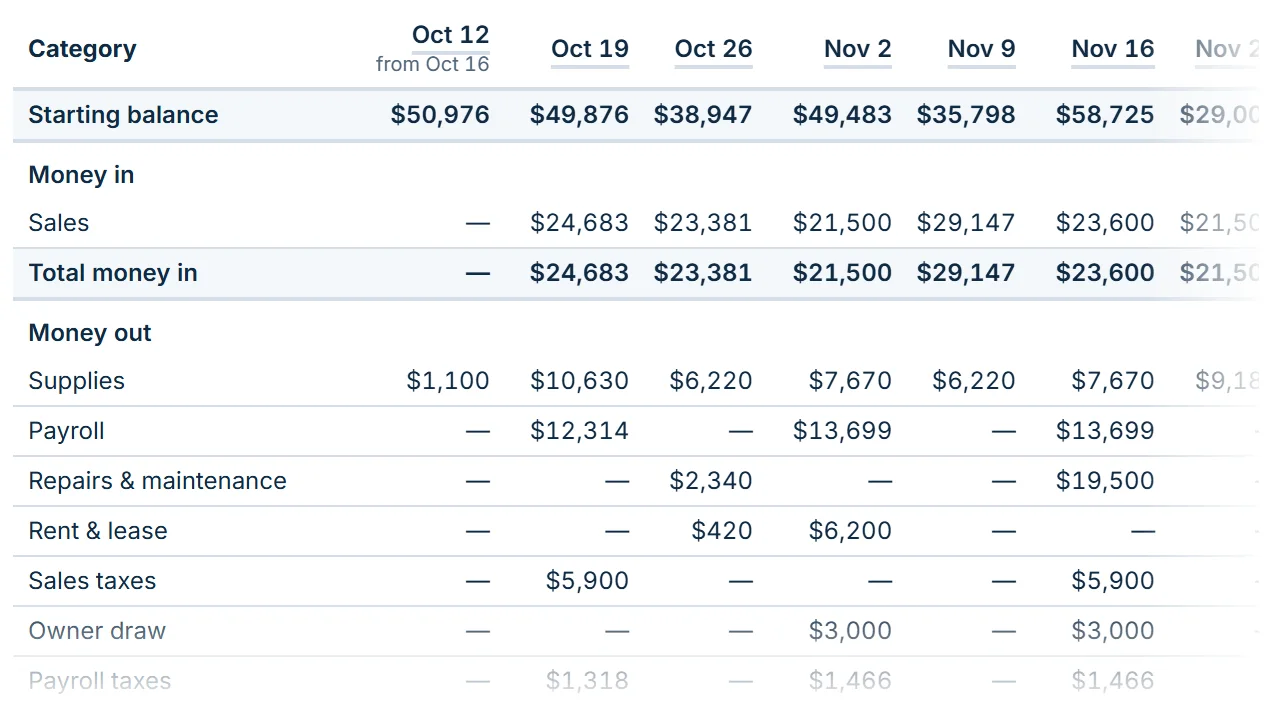
Thirteen columns, one per week. Money in on top, money out below, and a closing balance carried from each week into the next. This business looks healthy in week 1 and is $11,200 under its cushion by week 8, and it can see that seven weeks ahead.
Closing cash, week by week
Scroll the table sideways for all 13 weeks. The shaded weeks are below the cushion.
| Week | 1 | 2 | 3 | 4 | 5 | 6 | 7 | 8 | 9 | 10 | 11 | 12 | 13 |
|---|---|---|---|---|---|---|---|---|---|---|---|---|---|
| Opening cash | $48,000 | $49,320 | $36,720 | $50,280 | $37,480 | $30,600 | $16,700 | $9,300 | $3,800 | $17,720 | $11,520 | $15,980 | $18,280 |
| + Customer payments | $14,500 | $9,000 | $21,000 | $8,500 | $6,000 | $7,500 | $5,000 | $16,000 | $19,500 | $22,000 | $12,000 | $24,000 | $20,500 |
| + Other income | $1,200 | $1,200 | $1,200 | ||||||||||
| - Payroll and payroll taxes | $18,400 | $18,400 | $18,400 | $18,400 | $18,400 | $18,400 | |||||||
| - Rent | $6,200 | $6,200 | $6,200 | ||||||||||
| - Vendors and bills | $5,800 | $3,200 | $4,100 | $2,900 | $5,500 | $3,000 | $4,800 | $3,100 | $4,400 | $3,600 | $4,200 | $3,300 | $4,700 |
| - Loan and card payments | $1,180 | $2,400 | $1,180 | $2,400 | $1,180 | $2,400 | |||||||
| - Taxes | $2,140 | $6,400 | $2,140 | ||||||||||
| Net cash flow | $1,320 | -$12,600 | $13,560 | -$12,800 | -$6,880 | -$13,900 | -$7,400 | -$5,500 | $13,920 | -$6,200 | $4,460 | $2,300 | $15,800 |
| Closing cash | $49,320 | $36,720 | $50,280 | $37,480 | $30,600 | $16,700 | $9,300 | $3,800 | $17,720 | $11,520 | $15,980 | $18,280 | $34,080 |
Why it works
Why 13 weeks, and why weekly
Profit is worked out at the end of the month. Payroll is due on Friday. A business can be profitable on paper and still not have the cash in the bank on the day it’s needed. Running out of cash is one of the most common ways a sound small business fails.
A 13-week cash flow forecast is built to catch it. Three things make it different from the cash flow report in your accounting software:
- It looks forward. A cash flow statement tells you where money went. A forecast tells you where your balance is going.
- It’s weekly. In a monthly total, a month with three paydays looks like any other. By week, you can see the third one coming.
- It’s short enough to be true. Inside one quarter you already know most of what will happen: the invoices you’ve sent, the bills you’ve received, every payday and every tax date.
The payoff is time. A shortfall you see seven weeks out is a phone call to a customer, a bill moved by a few days, or a conversation with your bank while you still look like a good risk. The same shortfall seen on the day is a missed payroll.
By month: every month ends above the cushion
By week: 3 weeks go under it
Step by step
How to build a 13-week cash flow forecast
It takes an afternoon the first time, and about half an hour a week after that.
- 1
Start from the cash in the bank today
Add up the balances of the accounts you pay from. Use the real bank balance rather than the balance in your books: uncleared checks and unreconciled items make them differ. This is week 1’s opening cash.
- 2
Lay out 13 weekly columns
One column per week, starting with the current week. Weekly matters because payroll, rent and a tax payment can land in the same week, and a monthly total hides that.
- 3
Put in the money you expect, by the week it arrives
Go customer by customer for anything large. Use the week each customer actually pays rather than the week the invoice is due: if a customer pays in 45 days, plan on 45. For card sales and other regular income, use your recent weekly average.
- 4
Put in the money going out, by the week it leaves
Payroll and payroll taxes on your real paydays. Rent, loan payments and subscriptions on their dates. Vendor bills when you’ll pay them. Sales tax, estimated income tax and insurance, which are easy to forget because they aren’t monthly.
- 5
Carry the balance forward
Each week’s closing cash is its opening cash, plus money in, less money out. That closing figure is the next week’s opening cash. Thirteen columns later you have the whole quarter.
- 6
Draw your line
Decide the balance you never want to go under: one payroll plus two weeks of your other regular bills is a common starting point. Mark every week that closes below it. Those weeks are what the forecast is for.
- 7
Update it every week
Replace last week’s forecast with what really happened, add a new week 13, and look at what changed. A forecast that isn’t rolled forward every week is a guess with a date on it.
Where it goes wrong
Five mistakes that make the forecast useless
- Using due dates instead of paying habits. An invoice due in 30 days from a customer who pays in 50 belongs in week 8, not week 5.
- Leaving an overdue invoice where it was. An unpaid invoice left in a past week is money you don’t have. Move it out, or take it out.
- Forgetting what isn’t monthly. Quarterly taxes, annual insurance, a three-paycheck month. These are the weeks that hurt, because nobody was looking.
- Counting a card payment twice. If the card’s charges are in the forecast, the payment to the card from your checking account isn’t a second expense.
- Not updating it. This is the one that ends most of them. A forecast built in March and opened again in June is history.
Or have it built for you
The same forecast, kept up to date on its own
Flocuity is the 13-week cash flow forecast without the spreadsheet. It reads your bank history, finds the payments and income that repeat, brings in open invoices and bills from QuickBooks Online or Xero, puts payroll and taxes on their real dates, and rolls forward every day.
It also takes care of the mistakes above: past-due invoices are moved out; quarterly and yearly payments sit on their dates; a card payment and the card’s charges are never both counted; it rolls forward on its own; and on Plus, each customer’s invoices are dated by when that customer really pays. It keeps a record of how close past forecasts came, so you know how far to trust this one.
See the cash flow forecasting software, or start a free trial.
Questions about the method
- What is a 13-week cash flow forecast?
- A week-by-week projection of the cash in your bank account over the next quarter: opening cash, the money you expect in, the money going out, and the closing balance for each of 13 weeks. It’s sometimes called a 13-week cash flow model, a 13-week cash flow projection, or a TWCF.
- Why 13 weeks, and not a year?
- Thirteen weeks is one quarter: far enough ahead to act on trouble, near enough that most of what’s in it is already known. A 12-month forecast is useful for planning, but by week 40 most of the numbers are assumptions.
- Who uses a 13-week cash flow forecast?
- Lenders and turnaround advisers ask for one, which is where the format comes from. CFOs and fractional CFOs run one as a matter of routine. It’s just as useful to the owner of a ten-person business, who usually has the same question and nobody to ask.
- Is it the direct method or the indirect method?
- Direct. A 13-week forecast lists actual cash receipts and payments by week. The indirect method, which starts from profit and adjusts for non-cash items, belongs to the cash flow statement in your accounting software and is no use for seeing which week payroll collides with rent.
- How often should it be updated?
- Every week. Last week’s figures become actuals, a new week goes on the end, and you compare what you forecast with what happened. That comparison is what makes next week’s forecast better.
- How accurate is a 13-week forecast?
- The first four weeks should be close, because most of what’s in them is already known. Weeks 9 to 13 are a direction more than a number.
- Is there a template?
- Yes. Our free Excel template has the 13 weekly columns, the formulas and a worked example. If you’d rather not maintain a spreadsheet, Flocuity builds and updates the same forecast from your bank data.
- What is the difference between a cash flow forecast and a budget?
- A budget is what you plan to earn and spend, usually by month and by category, and it includes things that aren’t cash. A cash flow forecast is when money actually lands in and leaves the bank. A business can be on budget and still miss payroll.
Try it with your own numbers
Answer a few questions, add your bank history, and see the next 13 weeks in about ten minutes. You don’t enter a card until you’ve seen your forecast.